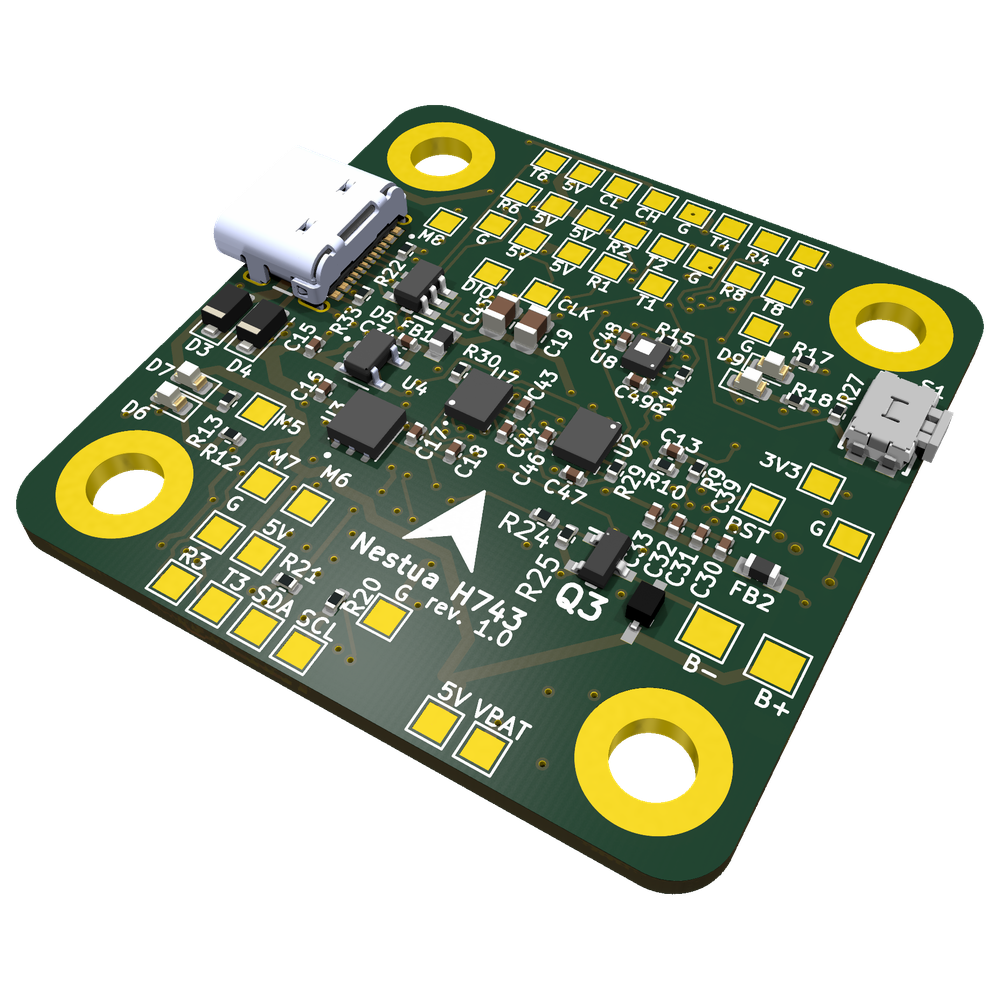
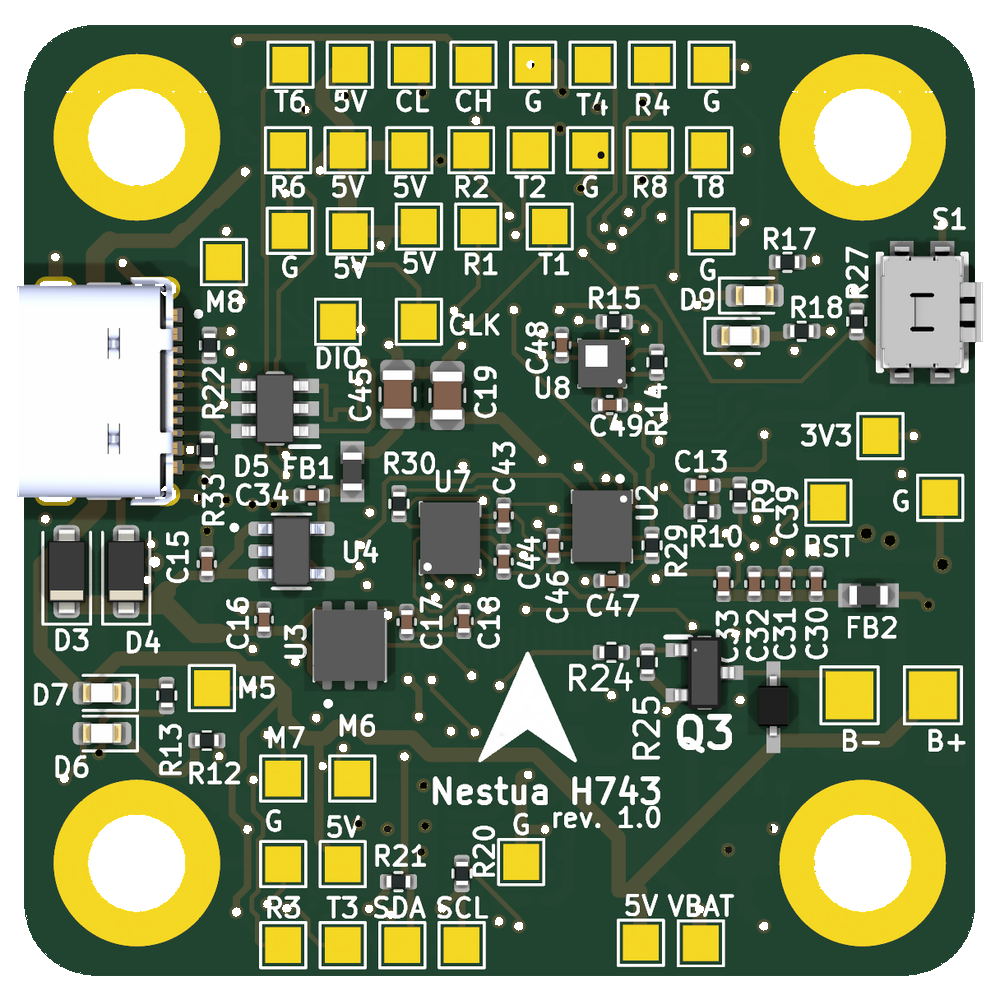
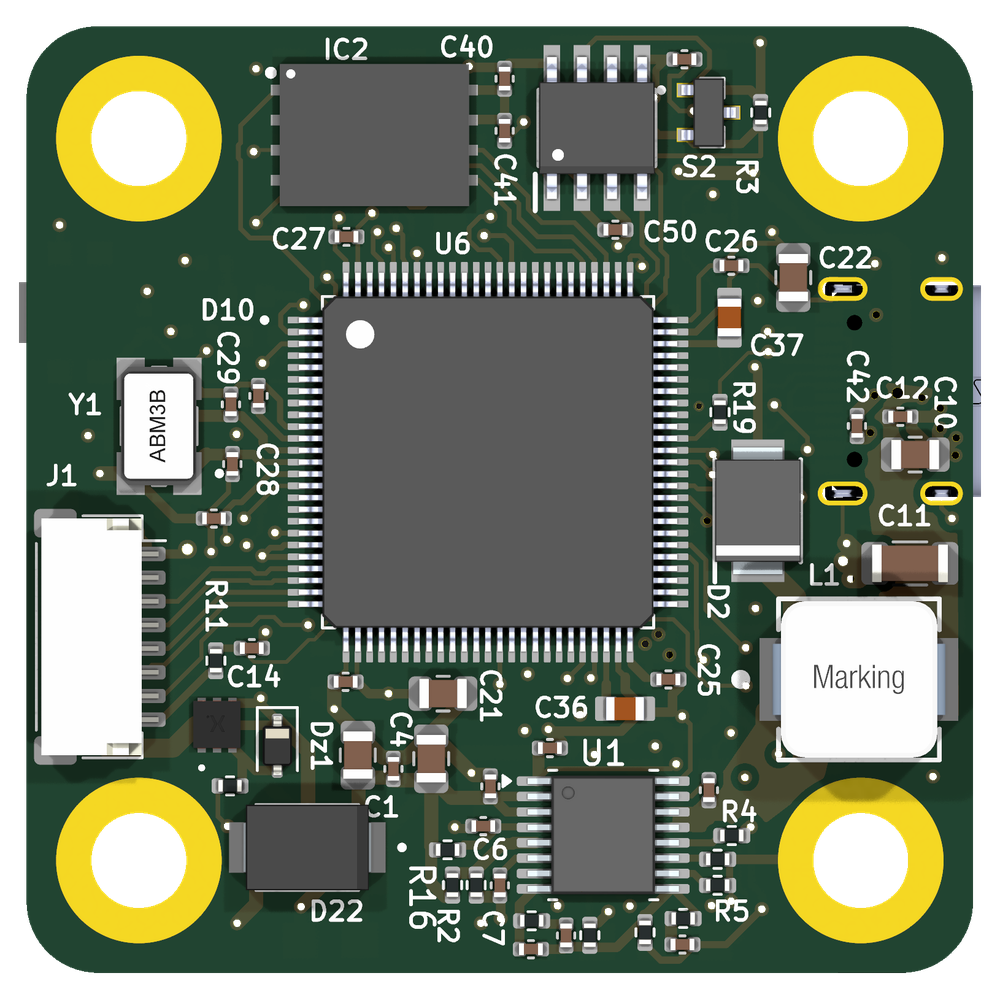
A 40×40 mm ArduPilot flight controller with an H7 processor, two IMUs on separate buses, 256 MB of onboard blackbox and CAN. Designed, built and flight-tested in Europe.
€199 excl. VAT · no payment to reserve
We designed the H743 for our own autonomous security drones. The same board is now available on its own.
The FC takes battery voltage over the standard 8-pin connector and makes its own 5 V and 3.3 V. Plug in the ESC you already have. No 5 V from the ESC needed.
Self-poweredEach IMU has its own SPI bus. The IMUs and barometer run from a separate low-noise analog 3.3 V regulator behind a ferrite, so switching noise from the 5 V supply stays out of the gyro data.
Clean power256 MB SPI NAND is soldered on the board. No SD card to vibrate loose. Full-rate IMU logging for tuning and incident analysis, downloadable over USB.
BlackboxA CAN port with an NXP transceiver, ESD protection and on-board termination. Connect DroneCAN GPS, compass, rangefinders and airspeed sensors over two wires.
DroneCANReverse-polarity FET and a 600 W TVS on the battery input. A 5 V 2 A switching BEC tested from 12 V to 24 V. USB and battery can be connected at the same time.
2–6SProcessor, barometer, IMU and power stage from STMicroelectronics, Bosch, NXP, Nexperia and Würth. PCB made and assembled in Europe.
Supply chain
| Processor | STM32H743VIT6, Cortex-M7 480 MHz, 2 MB flash, 1 MB RAM |
|---|---|
| IMU | Dual, two manufacturers, separate SPI buses (incl. Bosch BMI270) |
| Barometer | ST LPS22HH (I2C) |
| Compass | None on board — external over I2C or CAN |
| Blackbox | 256 MB (2 Gbit) Winbond W25N02KV SPI NAND |
| UARTs | 7 (one assigned to ESC telemetry) |
| Motor outputs | 8× PWM / DShot in two timer groups (4 + 4) |
| CAN | 1× FDCAN, NXP TJA1057 transceiver, ESD, 120 Ω termination |
| I2C | 2 buses (internal barometer + external) |
| OSD | Digital, MSP DisplayPort |
| USB | USB-C, USB 2.0 full speed, ESD protected |
| Input voltage | 2–6S LiPo (7–25.2 V), from the ESC connector |
| Protection | Reverse-polarity P-FET, SMBJ30A 600 W TVS |
| BEC | 5 V 2 A switching regulator (ST L7987) |
| 3.3 V rails | Digital LDO + separate low-noise analog LDO for sensors |
| ESC connector | JST-SH 1.0 mm 8-pin: GND · VBAT · M1 · M2 · M3 · M4 · TLM · CUR |
| Board size | 40 × 40 mm, 4-layer |
| Mounting | 30.5 × 30.5 mm, Ø4 mm holes (M3 with grommets) |
| Firmware | ArduPilot (ArduCopter), pre-flashed |
| Ground station | Mission Planner, QGroundControl, MAVProxy |
Same order as most 4-in-1 ESCs on the market. A standard SH1.0 8-pin cable plugs straight in.
No 5 V pin. Check your ESC's pin order before plugging in — a few brands differ.
Every board revision goes through a documented bring-up and flight test before it goes into production.
Every rail measured, from USB alone and from 12 V and 24 V bench supplies. Both IMUs, barometer and blackbox verified; a 1.17 MB log written and read back with zero missing bytes.
Flown on our quad frame with full-rate logging. Logs analysed against both IMUs and both EKF lanes.
Each board is flashed, powered from USB and battery, and has its sensors, blackbox and outputs checked before it ships.
Inspection, mapping and security drones on ArduPilot. CAN peripherals, a real blackbox and a documented supply chain.
Enough CPU for experiments, full-rate logs for papers, and a European supplier you can invoice.
GPS modes, digital OSD, return-to-home and missions on a standard 30.5 mm stack.
An H7 board with two IMU lanes and fast logging, from a team that works on the firmware too.
€199 excl. VAT. No payment now — we'll email you the ship date for the first batch, and you pay only when you confirm.
We use your email only for this pre-order. No newsletter unless you ask for it.